
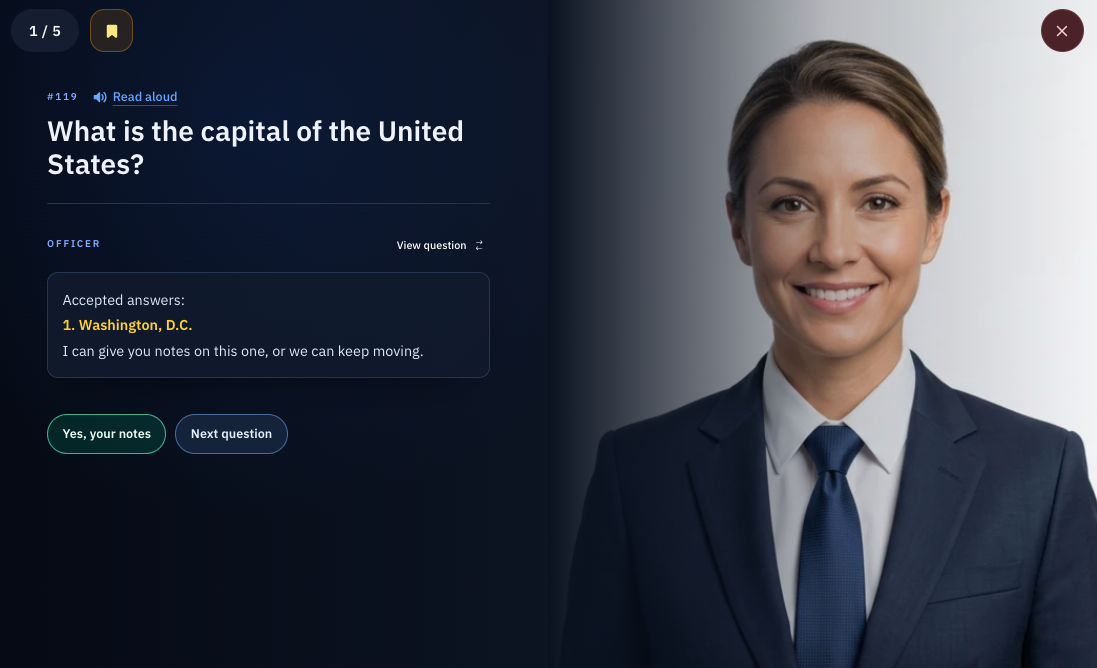
A Study session: the officer reveals the accepted answer and offers notes before moving on.
CitizenMate helps people prepare for the U.S. naturalization interview. I co-founded the company and built the product, from the idea and UX/UI to architecture and all of the code. It launched in 2026 and is live in production, with a free trial open to everyone.
VISIT CITIZENMATE AT: CITIZENMATE.COM
Why I built it
I moved to the United States from Belarus, so I know the citizenship interview is the last step of a much longer road: a new language, a new culture, and a career rebuilt from the ground up. After all that, a short interview can still feel intimidating when you have to answer in a language you didn't grow up speaking.
I've also always learned better through conversation than through memorization. I wanted a study partner who would ask me questions, explain what I missed, and help me reach the answer on my own. CitizenMate is my attempt at building that kind of learning tool, and it works on me too: after dozens of practice interviews, I understand American history and government better than when I started. If it helps someone walk into their interview feeling ready, that's the result I care about most.
The idea
The civics part of the citizenship interview isn't a written test. An officer asks questions out loud, and the applicant answers out loud, in English, often while nervous. Most prep tools are flashcards or quizzes. They help people memorize, but they don't prepare anyone to hear a question and say the answer to a person.
So CitizenMate is built around speaking. You practice with an AI interview officer, and you're graded the way a real officer would grade you. A little pressure is intentional: knowing an answer and saying it out loud while someone waits are different skills, and practice is the safe place to feel that nervousness and try again.
What it does
- Voice-first sessions. The officer asks each question aloud, and you answer by voice, with typing as a fallback.
- Three modes. Study teaches as you go. Practice is supportive, with hints and retries. Strict Exam behaves like the real interview.
- Personal answers. Questions about your own senators or representative are answered for your address and kept current from official sources.
- Feedback. Each answer gets a short explanation, and each session ends with coaching on what to review next.
- Study library and progress tracking, plus a one-question demo before sign-up.
How it's built
It's a Ruby on Rails monolith with Hotwire and PostgreSQL, deployed with Kamal. Speech-to-text, text-to-speech, and LLM providers plug into it, and Stripe handles payments. One codebase and one database keep a small team fast, and Turbo makes the server-rendered pages feel responsive.
A few decisions shaped most of the product.
Grading is deterministic, and AI handles only the close calls
Sending every answer to an LLM would be slower and more expensive, and it wouldn't be consistent: the same answer could pass one day and fail the next. A test-prep product can't work like that.
So grading is rule-based by default. Each question is modeled as a set of accepted ideas, not a single "correct" string, and answers are normalized the way people actually speak ("eighteen twelve" counts as 1812). Clear answers are decided instantly. Only true near-misses, like "religious freedom" for "freedom of religion", go to an AI reviewer, and if that call fails, the rule-based grade stands.
The AI officer suggests, and the app decides
The officer should feel human. It can ask you to try again, give a hint, or respond when you say "sorry, I'm nervous." It must never give away an answer during an exam or change a grade.
So the model only proposes what to say and what to do next, from a small set of allowed actions. The app checks that proposal against the current mode and its rules before anything happens. Small talk and retries never touch the score. A question is graded only when the app decides it's finished.
Nothing gets stuck
Voice products depend on many services, and any of them can be slow or down. Every answer has one time budget. A failed call gets a retry, then a backup provider, then a safe pre-written officer reply, so the interview always keeps going. Every call is also tracked for speed, reliability, and cost. That data is what made fair per-question pricing possible.
Audio that feels natural
Browsers and devices handle microphones very differently. The app records only when it expects you to speak, shows what it heard before grading it, and falls back to typing if the microphone fails. Common officer lines are pre-recorded, so playback is instant, and only truly dynamic replies are generated on the fly.
Billing you can trust
Practice runs on credits from monthly plans or top-ups. Every credit movement is a permanent ledger entry. Credit is reserved when a session starts, so two sessions can't spend the same balance, and payment events are processed exactly once.
My role
As co-founder and engineer, I owned product decisions, UX/UI design, architecture, the full-stack build, billing, internationalization, and deployment. I used AI coding tools throughout to move faster on the parts I already understood. Design, review, and testing stayed with me.
Building something similar?
If you're working on voice interaction, AI features that need to behave predictably, or usage-based billing, I've solved exactly those problems in production. I'm happy to talk, whether you're hiring for your team or looking for someone to build it with you. Get in touch.